
What Is the Difference Between Flush-Fit and Extended Magazines?
Estimated reading time: 5 min
Summarize with AI
Share
Quick Answer
Flush-fit magazines sit even with, or nearly even with, the bottom of a firearm’s grip or magazine well. Extended magazines project below the grip or magazine well. The difference affects overall size, grip space, capacity potential, storage, and compatibility.
- Flush-fit: Maintains the firearm’s intended grip profile and compact dimensions. It may be preferable when minimizing bulk or protrusion matters.
- Extended: May provide additional grip surface, additional cartridge capacity, or both. It also adds length below the firearm.
- Capacity: An extended magazine does not always hold more ammunition. Some extensions are enlarged base pads or grip extensions that do not change internal capacity.
- Compatibility: Caliber alone does not determine fit. Match the magazine to the firearm’s exact make, model, configuration, and manufacturer specifications.
Neither format is automatically more reliable or suitable for every shooter. The practical choice depends on firearm compatibility, intended use, hand fit, desired profile, and applicable capacity restrictions. Shoppers comparing handguns should also consider whether the grip was designed around a flush-fit magazine or benefits from a matching sleeve on an extended one.
What Flush-Fit and Extended Actually Mean
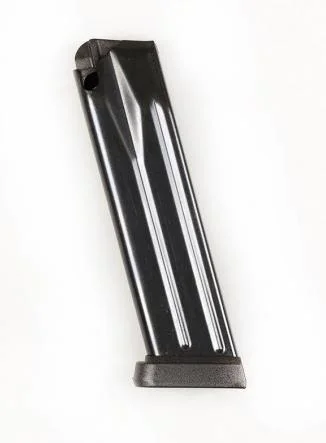
A flush-fit magazine follows the lower contour of the grip or magazine well without substantial projection. On compact firearms, this design helps preserve the shorter profile that distinguishes the model. On some rifles, a lower-profile magazine can also reduce bulk during transport or storage.
An extended magazine projects beneath the firearm. It may use a longer magazine body to create additional internal space, or it may use an extended base pad that changes the exterior shape without adding capacity. A grip extension can provide a resting surface for more of the shooter’s hand while leaving the magazine’s internal dimensions unchanged.
Product terminology is not always consistent across manufacturers. Read the listed capacity, compatible firearm models, magazine-body specifications, and extension description rather than relying only on words such as extended, plus, or grip extension.
Practical Tradeoffs: Profile, Grip and Capacity
Flush-fit magazines preserve the firearm’s original grip length and generally create less protrusion. That can make the firearm easier to fit into appropriately sized storage equipment and may reduce interference with certain fitted accessories. The tradeoff is that a short grip may leave less surface for some hand sizes.
Extended magazines can provide more grip area and may offer greater capacity when the magazine body and internal components are designed accordingly. The added length changes the firearm’s overall profile, however, and can affect fit in cases, storage compartments, or other equipment. A large extension can also create a visible gap below a compact grip unless the magazine includes a model-specific sleeve.
Hand comfort is individual. An extension that feels helpful to one owner may place another owner’s fingers awkwardly against a seam or sleeve. Whenever possible, compare the manufacturer’s dimensions and photographs with the firearm’s grip shape. Follow the firearm and magazine manufacturers’ instructions and seek qualified instruction when needed.
Magazine capacity and possession requirements can vary and change. Check current federal, state and local law before purchasing or using any magazine.
Compatibility and Construction Matter More Than Length
A magazine marked for the correct cartridge may still be incompatible with a particular firearm. Magazine-catch location, body dimensions, feed-lip geometry, follower design, spring specifications, and firearm generation can differ. Even closely related models may not accept the same magazine, or an extended magazine may fit one member of a firearm family but not another.
Factory specifications should identify the exact compatible models. For aftermarket products, look for equally specific fit information and determine whether the extension is a complete magazine, a replacement base pad, or a capacity-changing component. If compatibility remains unclear, consult the firearm manufacturer, magazine manufacturer, or a qualified gunsmith.
Construction quality also deserves attention. Examine product descriptions for magazine-body material, follower design, spring type, base-pad configuration, and serviceable components. A sleeve intended to fill the space between an extended magazine and a compact grip must also be made for that combination; a generic-looking sleeve should not be assumed to fit.
For safe handling, remember: Treat every firearm as if it is loaded. Keep the muzzle pointed in a safe direction. Keep your finger off the trigger and outside the trigger guard until your sights are on the target and you have decided to shoot. Be sure of your target and what is beyond it.
How to Choose Between Flush-Fit and Extended Magazines
Start with compatibility, then evaluate how the magazine will be used. A flush-fit model may make sense when preserving compact dimensions, original appearance, or fitted-storage compatibility is the priority. An extended model may be appropriate when additional grip surface or manufacturer-specified capacity is more important than minimizing length.
- Confirm the exact firearm: Match make, model, configuration, cartridge, and any generation designation.
- Verify actual capacity: Do not assume every extended base pad increases internal capacity.
- Consider grip fit: Determine whether the extension adds usable hand space and whether a fitted sleeve is included or required.
- Check equipment fit: Account for the magazine’s total length when selecting cases and storage.
- Review maintenance needs: Follow manufacturer guidance for inspection, disassembly, spring replacement, and compatible cleaning and maintenance products.
Before cleaning or inspecting a firearm, unload it, remove the magazine, lock the action open, and visually and physically check that the chamber is empty.
Whether you want a compact factory-profile option, additional grip length, or a model-specific higher-capacity design, browse BT Gun Company’s magazines and compare the listed fit and specifications before ordering.

About the Author: Jeff Brown
Jeff Brown is CEO of Fuzzy Holdings LLC and owner of BT Gun Company, a Class 7 FFL dealer since 2023. An NRA-certified Range Safety Officer who has been shooting since 1983, he teaches hunter safety at his local gun club, hunts spring and fall turkey, and has a soft spot for revolvers.