
What Is the Main Difference Between Centerfire and Rimfire Ammunition?
Quick Answer
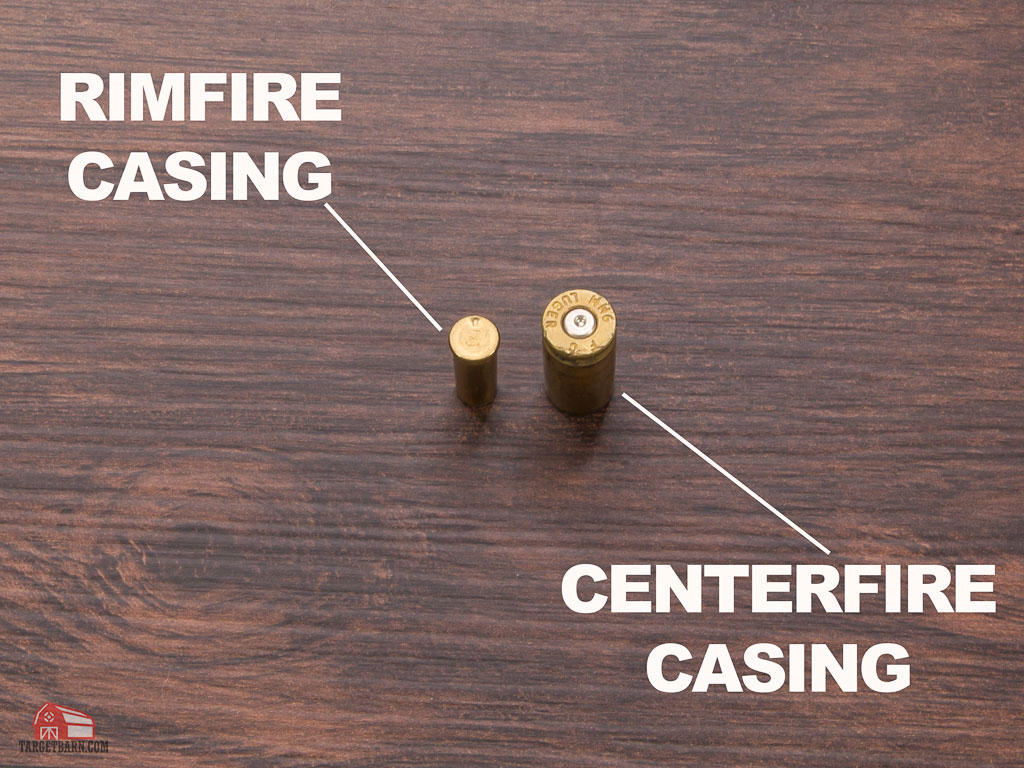
The main difference between centerfire and rimfire ammunition is the location and design of the priming system that ignites the powder charge. A centerfire cartridge has a distinct primer seated in the center of its case head. A rimfire cartridge carries its priming compound inside the hollow, folded rim around the edge of the case.
- Centerfire: The firing pin strikes a primer in the center of the cartridge base. Common examples include .380 ACP, 9mm Luger, .45 ACP, .223 Remington, 5.56 NATO and .308 Winchester.
- Rimfire: The firing pin crushes the cartridge’s outer rim against the chamber, igniting priming compound distributed inside that rim. Common examples include .22 Long Rifle, .22 Winchester Magnum Rimfire and .17 HMR.
This construction affects more than ignition. Centerfire cases can have thicker case heads and are generally suited to higher-pressure, larger-caliber loads. Their replaceable primers also make suitable Boxer-primed brass cases practical to reload. Centerfire ammunition is consequently the standard choice for defensive handguns, most modern rifles, hunting larger game and many competitive shooting disciplines.
Rimfire ammunition is normally associated with small-caliber cartridges. It generally offers low recoil, modest noise and lower ammunition cost, making .22 LR especially popular for introductory instruction, recreational target shooting, small-game hunting and high-volume practice. Rimfire ignition can be less consistent because the primer compound must be distributed around the case rim, and fired rimfire cases are not normally reloaded.
You can often identify centerfire ammunition by the separate circular primer visible in the middle of the case head. A rimfire case lacks that central primer and instead has a crushable outer rim. Do not rely on bullet diameter alone: .22 LR is rimfire, while similarly named cartridges such as .223 Remington are centerfire and are completely different in dimensions, pressure and intended firearms.
Centerfire and rimfire cartridges are never interchangeable unless the firearm is specifically designed or converted for the exact cartridge. Always use the precise cartridge designation marked on the firearm and confirmed in its owner’s manual.
How Centerfire and Rimfire Priming Systems Work
When a centerfire firearm’s trigger is pressed, the firing mechanism drives the firing pin or striker into the primer cup at the center of the case head. The primer composition ignites, sending flame through the case’s flash hole and into the propellant. Expanding gas then drives the bullet through the barrel.
Two centerfire primer systems are widely recognized. A Boxer-primed case typically has one central flash hole, with the anvil built into the removable primer. A Berdan-primed case has its anvil formed into the case and commonly uses multiple flash holes. Boxer-primed brass is prevalent in the United States and is generally more convenient for experienced handloaders to process, but a fired case must still be inspected and verified as suitable before reuse.
Rimfire cases do not contain a separate primer cup. During production, priming material is placed inside the case and distributed into its hollow rim. The firing pin strikes and pinches that rim against the chamber edge to initiate ignition. This requires a relatively thin, deformable case rim, which is one reason modern rimfire cartridges are concentrated in smaller calibers.
The Sporting Arms and Ammunition Manufacturers’ Institute technical resources provide authoritative information about cartridge standards, terminology and safe ammunition practices.
Reliability, Power and Reloading Differences
Centerfire ammunition generally provides more dependable ignition than rimfire ammunition because every cartridge has a self-contained primer positioned directly under the firing pin. That reliability is important in defensive firearms, duty guns, hunting rifles and competitions where a failure to fire can have serious consequences.
Centerfire construction also supports an enormous performance range. It includes compact handgun cartridges such as .380 ACP, mainstream defensive rounds such as 9mm Luger and rifle cartridges such as .308 Winchester. Most modern shotgun shells likewise use a centrally located primer. Centerfire does not automatically mean powerful, but nearly all contemporary high-pressure service and big-game cartridges are centerfire designs.
Rimfire does not automatically mean weak. Cartridges such as .22 WMR and .17 HMR provide more velocity and reach than typical .22 LR loads, although performance varies by load and barrel length. Nevertheless, rimfire remains best known for light recoil, accessible practice and small-game applications.
Reloadability is another practical distinction. Many Boxer-primed centerfire brass cases can be reloaded with the correct equipment, published load data and proper training. Rimfire cases are crushed during firing and contain an integral priming arrangement, so ordinary shooters do not reload them using conventional centerfire equipment.
Which Ammunition Type Should You Choose?
Choose ammunition according to the firearm, intended use and exact chamber marking. A Ruger 10/22 or Ruger Mark IV chambered in .22 LR gives new and experienced gun owners an economical platform for fundamentals, recreational shooting and skill maintenance. The mild recoil of .22 LR can make it easier to concentrate on sight alignment, trigger control and safe gun handling.
Centerfire is usually the appropriate choice for personal protection, service-style training, medium- or large-game hunting and longer-range rifle shooting. Examples include 9mm pistols, .223 Remington rifles and .308 Winchester hunting rifles, but cartridge selection must always match the chamber and task.
Cost per round is commonly lower for .22 LR than for centerfire cartridges, although retail pricing changes with brand, load, packaging and market supply. Rather than choosing solely by price, consider ignition reliability, terminal-performance requirements, recoil tolerance, firearm availability and the rules governing your shooting discipline.
Gun owners can browse firearms and ammunition through BT Gun Company. For current policy developments affecting lawful ownership, training and access, follow the site’s latest firearms news.
Safe Handling and Cartridge Compatibility
Neither ignition system changes the fundamental rules of firearm safety. Keep every firearm pointed in a safe direction, keep your finger off the trigger until ready to fire, and know your target and what is beyond it. Wear appropriate eye and hearing protection at the range.
Read the complete cartridge designation on the barrel, slide or receiver and compare it with the ammunition box and cartridge headstamp. Similar numbers do not establish compatibility. For example, .22 LR, .22 WMR and .223 Remington are distinct cartridges and must not be substituted for one another. Likewise, .223 Remington and 5.56 NATO should only be used as permitted by the firearm manufacturer and the firearm’s marked chamber.
If a cartridge fails to fire, keep the muzzle pointed in a safe direction and follow the firearm and ammunition manufacturers’ misfire procedures. Do not immediately open the action or inspect the muzzle. Damaged, corroded, contaminated or incorrectly identified ammunition should not be fired.
Whether you need a rimfire trainer, a centerfire defensive handgun or dependable range supplies, visit BT Gun Company to shop firearms and accessories from a licensed FFL dealer.

About the Author: Jeff Brown
Jeff Brown is CEO of Fuzzy Holdings LLC and owner of BT Gun Company, a Class 7 FFL dealer since 2023. An NRA-certified Range Safety Officer who has been shooting since 1983, he teaches hunter safety at his local gun club, hunts spring and fall turkey, and has a soft spot for revolvers.