What Should You Know Before Buying Binoculars? A Gun Owner’s Guide
Quick Answer
Before buying binoculars, decide how and where you will use them. Magnification alone does not determine quality. Hunters, shooters, wildlife observers, and range users should balance magnification, objective-lens diameter, field of view, low-light performance, size, weight, durability, and eye comfort.
- Start with the configuration: The first number is magnification, and the second is objective-lens diameter in millimeters. An 8×42 binocular magnifies eight times and has 42mm objective lenses.
- Choose practical magnification: An 8×42 is a versatile, relatively steady handheld option for woods and general observation. A 10×42 provides more apparent reach across fields or open country but can make hand movement more noticeable.
- Consider low-light use: Larger objective lenses can gather more light, but optical coatings, glass quality, and overall design also affect brightness and contrast. Bigger lenses usually add weight and bulk.
- Check the field of view: A wider field makes it easier to locate moving animals, scan timber, or follow activity at a shooting match. Field of view is normally listed in feet at 1,000 yards or as an angular measurement.
- Test eye comfort: Confirm that the center hinge fits your interpupillary distance, the focus wheel is easy to operate, and the diopter adjustment produces a sharp image for both eyes. Eyeglass wearers should pay particular attention to usable eye relief and adjustable eyecups.
- Demand appropriate durability: Hunters should look for weather sealing, internal fog resistance, protective lens coatings, and an exterior that remains secure in wet or gloved hands. Verify the manufacturer’s exact waterproof and warranty terms rather than relying on vague claims.
- Inspect before deciding: Look through binoculars in bright light, shade, and toward fine details. Check edge sharpness, color fringing, glare, focus feel, and whether the image causes eye strain.
For most gun owners seeking one general-purpose binocular, 8×42 or 10×42 is a sensible starting point. Buy the model that delivers a comfortable, clear image in your actual conditions—not simply the highest magnification or largest objective lens.
Understanding Magnification, Objective Size, and Exit Pupil
Binocular names encode two important specifications. In an 8×42 model, “8x” is the magnification and “42” is the objective-lens diameter in millimeters. Higher magnification reveals more apparent detail at distance, but it also magnifies hand shake and commonly reduces field of view when comparing related models. That tradeoff matters when scanning dense woods, locating game quickly, or watching impacts at the range.
Objective size affects physical dimensions and potential light-gathering ability. Compact 8×25 binoculars are easier to carry, while 8×42 and 10×42 configurations offer a popular balance of brightness, handling, and portability. A 50mm objective may be useful when low-light performance is a priority, but the additional size and weight can become noticeable during an all-day hunt.
Exit pupil is calculated by dividing objective diameter by magnification. An 8×42 has a 5.25mm exit pupil, while a 10×42 has a 4.2mm exit pupil. A larger exit pupil can make eye placement more forgiving and support a brighter-looking image under dim conditions, although coatings, glass, internal baffling, and the user’s eyes remain important.
Compare Glass, Coatings, Prisms, and Image Quality
Binoculars generally use roof-prism or Porro-prism designs. Roof-prism models tend to have a straight, streamlined body that is convenient in a chest harness. Porro-prism binoculars use an offset shape and can provide strong optical performance, although they are often bulkier. Neither layout guarantees quality by itself.
Extra-low-dispersion glass, often labeled ED, can reduce visible color fringing and improve fine-detail rendering when properly incorporated into the optical system. Lens and prism coatings can improve light transmission, contrast, and glare control. Terms such as “multi-coated” and “fully multi-coated” are useful comparison points, but buyers should review each manufacturer’s definitions and judge the complete image rather than treating one label as proof of performance.
Test sharpness in the center and near the edges. Examine dark branches against a bright sky for color fringing, then look into shaded areas for contrast. Focus from near to far and confirm that the mechanism moves smoothly without unwanted play. Optical quality is especially valuable during the low-light periods when game is often active and accurate identification matters most.
Fit, Weather Protection, and Field Durability
A binocular can have excellent glass and still be a poor purchase if it does not fit the user. Adjust the hinge until both images merge into one circle, set the diopter for differences between your eyes, and confirm that the eyecups provide a full image without dark crescents. If you wear glasses, test the binocular with them rather than relying only on a published eye-relief number.
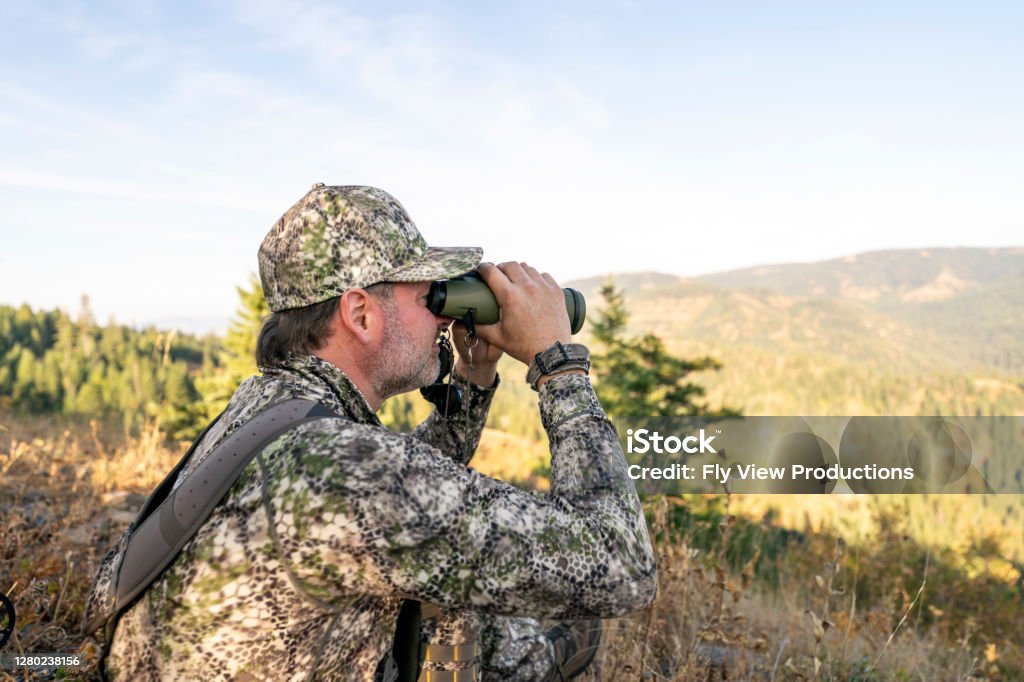
For hunting and outdoor range use, confirm whether the binocular is waterproof, nitrogen- or argon-purged, and covered against internal fogging under the manufacturer’s stated conditions. Examine the hinge, eyecups, focus wheel, lens covers, and exterior armor. Also consider total carried weight after adding a neck strap, chest harness, or tripod adapter. A stable 10x or higher-magnification view may benefit from supported observation, particularly during extended glassing.
Binoculars are also an important firearms-safety tool because they let hunters identify distant objects without aiming a rifle at them. A rifle scope should never replace dedicated observation equipment. Review the NSSF rules of firearm safety, including keeping the muzzle pointed in a safe direction and being certain of the target and what lies beyond it.
Match the Binocular to Your Hunt, Range, and Budget
Woodland hunters often favor a wide field of view, manageable size, and fast handling, making 8×42 a logical configuration to evaluate. Hunters crossing open plains, agricultural ground, or mountain terrain may appreciate the added apparent detail of 10×42. Compact binoculars suit packs, vehicles, and casual range bags, but their smaller controls and objective lenses may be less forgiving in cold weather or fading light.
Rangefinding binoculars combine observation and distance measurement, but they add electronics, controls, battery requirements, weight, and cost. Before buying one, verify the manufacturer’s ranging limitations, display visibility, warranty coverage, and whether its ballistic or angle-compensation features match your intended use. A conventional binocular paired with a separate rangefinder may be more flexible for some owners.
Set a budget around the complete field kit rather than glass alone. Account for a protective case, harness, lens-cleaning supplies, tripod adapter if needed, and replacement covers. Avoid cleaning dust with a shirt or dry cloth; remove loose grit first and use products intended for coated optics. Gun owners can explore accessories, browse firearms, and follow the latest firearms news from BT Gun Company.
Ready to complete your hunting or range setup? Visit BT Gun Company to shop dependable firearms and gear backed by an experienced licensed FFL dealer.

About the Author: Jeff Brown
Jeff Brown is CEO of Fuzzy Holdings LLC and owner of BT Gun Company, a Class 7 FFL dealer since 2023. An NRA-certified Range Safety Officer who has been shooting since 1983, he teaches hunter safety at his local gun club, hunts spring and fall turkey, and has a soft spot for revolvers.