
What Is a Gun Safe? Firearm Storage, Locks, and Protection Explained
Estimated reading time: 8 min
Summarize with AI
Share
Quick Answer
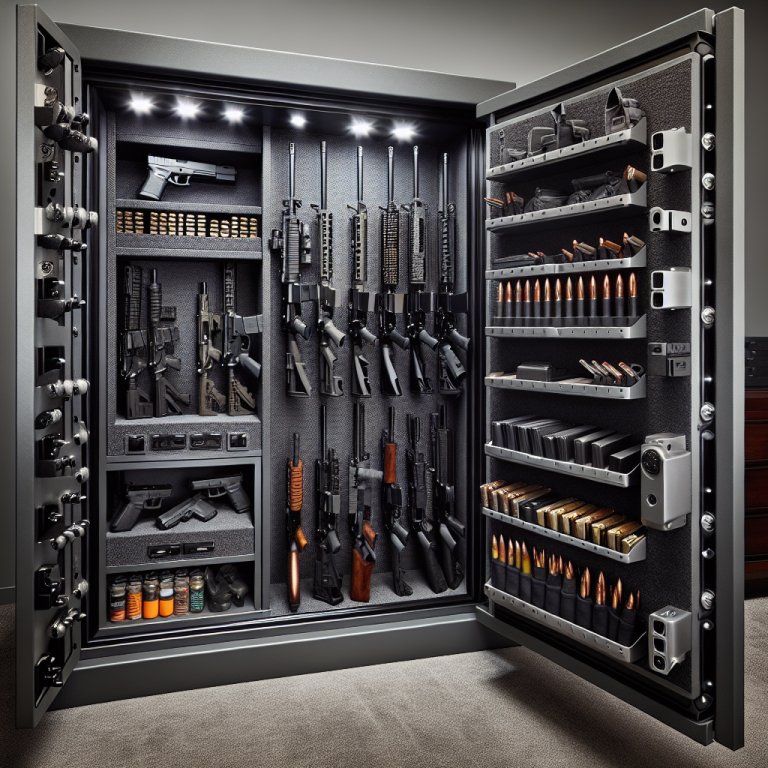
A gun safe is a lockable security enclosure designed to store firearms and restrict unauthorized access. Typically made of steel, it combines a reinforced body and door with a locking mechanism. Depending on its construction and verified ratings, it may also provide resistance to theft or fire. Those protections vary substantially: the words gun safe alone do not establish a particular security standard.
Gun safes range from compact handgun containers to freestanding cabinets sized for rifles, shotguns, and handguns. Their central purpose is to keep firearms under the owner’s control when they are stored. For responsible gun owners, secure storage supports both the exercise of Second Amendment rights and the protection of family members, visitors, and valuable firearms.
- Access control: A key, combination dial, electronic keypad, or biometric reader limits who can open the enclosure. Protecting backup keys and access codes is part of the system.
- Theft resistance: Body construction, door design, locking components, installation, and independently verified ratings matter more than appearance.
- Fire protection: Some safes include insulation and tested fire resistance. A burglary rating does not establish fire performance, and no safe should be assumed fireproof.
- Organization: Racks, shelves, and handgun supports help separate firearms, but advertised capacity may not reflect the space occupied by scopes and other attachments.
- Practical fit: The right enclosure must accommodate your firearms, your available installation space, and the people authorized to access it.
For firearms not in use, NSSF recommends unloaded, locked storage with ammunition secured separately. A safe complements careful handling; it does not replace checking a firearm’s condition or following its owner’s manual.
Before buying, identify your main concern: unauthorized household access, theft, fire exposure, or a combination. Then compare documented protection, usable interior dimensions, lock operation, and installation requirements. Budget for delivery and anchoring where required, rather than treating the advertised purchase price as the entire project.
A well-chosen gun safe is a practical ownership tool. Whether you have one handgun or a growing collection, plan secure storage before bringing another firearm home. BT Gun Company is a licensed FFL dealer in Rubicon, Wisconsin, serving shooters across Dodge, Washington, Waukesha, and nearby counties.
What Makes a Gun Safe Different From a Cabinet or Lockbox?
These product names describe overlapping categories, so examine construction and testing rather than relying on the label. A steel cabinet can provide locked storage without offering the forced-entry resistance of a more substantial safe. A compact handgun lockbox may suit a small space, but its portability makes its attachment method especially important.
A freestanding gun safe generally provides a larger enclosure, with a door and locking assembly intended to resist unauthorized opening. However, a large exterior, glossy finish, or imposing handle does not establish how well it performs. Ask what protection the manufacturer documents for that specific model.
Match the container to the job
- Handgun storage: Check usable space with the firearm’s actual dimensions and any mounted optic or light.
- Long-gun storage: Check interior height, rack placement, and clearance around scopes and bolt handles.
- Mixed collections: Decide how shelves and handgun storage affect the remaining rifle space.
- Portable storage: Review the manufacturer’s approved method of securing the container to a suitable structure.
Think of access control and resistance to forced entry as separate questions. A container can keep a firearm out of casual reach while providing limited resistance to a determined thief. Your purchase should reflect the protection you need, rather than an assumption that every locking steel box offers equivalent security.
How Does a Gun Safe Lock Work?
A safe’s lock controls the mechanism that secures its door. On many full-size models, entering the correct combination releases the mechanism so the handle can retract locking bolts or bars. The handle, lock, and door components work together; a high-quality lock cannot compensate for every weakness elsewhere in the enclosure.
Common access methods
- Mechanical combination dial: Uses a prescribed dialing sequence. A conventional mechanical dial does not require a battery for normal operation.
- Electronic keypad: Accepts a numerical code. Follow the exact battery specifications and replacement instructions supplied with the lock.
- Biometric reader: Uses an enrolled biometric identifier, commonly a fingerprint. Evaluate the model’s documented operation and authorized backup access procedure.
- Keyed lock: Requires physical control of the key, including every spare.
Before choosing, consider who will operate the lock and whether they can use it consistently. Read the instructions for code changes, incorrect-entry lockouts, battery replacement, and service. These procedures vary. For example, Liberty’s service guidance directs owners with mechanical dial locks to a locksmith or dealer for combination resets.
Set up and test the lock using the manufacturer’s instructions before storing firearms. Keep access credentials away from unauthorized users, and review who has access whenever household circumstances change. Do not assume closing the door automatically locks every model; verify that the enclosure is secured after use.
What Do Burglary and Fire Ratings Actually Mean?
Security ratings and fire ratings answer different questions. One concerns resistance to forced entry; the other concerns performance during specified heat exposure. Neither is a promise that the contents will survive every incident.
One designation buyers encounter is Residential Security Container, or RSC. UL evaluates these containers against defined attack conditions. Its explanation of the standard distinguishes security containers from fire-resistant containers. The useful takeaway is to look for the actual certification and classification, rather than assuming every product called a safe has passed the same evaluation. See UL’s explanation of residential security container testing.
Also distinguish certification of a component from certification of the container. A listed lock is meaningful information about that lock; it does not, by itself, establish a burglary or fire rating for the entire safe.
Questions to ask about fire claims
- Who conducted or certified the test?
- What temperature, duration, and internal temperature limit were used?
- Does the published result apply to this exact model?
- What does the warranty cover after a fire?
A headline such as “60 minutes” lacks context without the test conditions. Manufacturers may use different protocols, so identical advertised durations are not necessarily equivalent. Liberty’s guide to safe ratings provides background on interpreting security and fire claims. Treat a replacement warranty as a separate consideration from the safe’s tested protective performance.
How Much Gun Safe Capacity Do You Need?
Start with a measured inventory. Include overall firearm length, the space needed around optics, and how you will reach individual firearms without moving several others. A .22 LR rifle, a scoped .308 Winchester hunting rifle, and a 12-gauge shotgun can have very different storage footprints. Caliber alone does not determine fit.
Advertised gun counts deserve particular scrutiny. Liberty explicitly notes that gun capacity varies with firearm and scope size. Its USA Series specifications also distinguish exterior dimensions from usable interior dimensions. That distinction matters when comparing safes that appear similar from the outside.
Make a simple layout before purchasing. Allocate room for long guns, handguns, and any other items you intend to store. Decide whether you need shelving more than additional rifle positions. Leave enough clearance to remove a firearm without knocking an adjacent scope or forcing the door against stored equipment.
Measure the delivery route as carefully as the intended location. Account for door openings, tight turns, stairs, handle projections, and the room needed to swing the safe door open.
When you browse firearms, include the storage footprint in your purchase planning. Buying adequate usable space now can avoid an immediate rearrangement when you add an optic or another firearm.
Where Should You Install a Gun Safe?
Choose a location that supports secure installation, routine use, and environmental protection. A location that makes storage inconvenient can undermine an otherwise thoughtful setup. Consider visibility from outside the home, the delivery route, available floor space, and access for authorized users.
Follow the manufacturer’s anchoring instructions for the specific enclosure and supporting surface. Weight alone should not be treated as an installation plan. Before drilling, have the installation method assessed for the floor construction and any concealed utilities. Heavy safes and difficult stairways warrant professional moving assistance.
Floor support deserves attention before delivery, especially in an older home or on an upper floor. Ask a qualified professional when the structure’s suitability is uncertain. Include the safe’s contents when evaluating the planned installation.
Moisture is another consideration. Wisconsin owners evaluating a basement or garage should assess actual conditions rather than assume either location is suitable. Liberty’s use-and-care guidance calls for protection from weather and excessive humidity and specifies a climate-controlled setting for its painted-surface warranty.
Inspect stored firearms periodically and follow their manufacturers’ maintenance instructions. A locked enclosure does not eliminate the need to address moisture, check firearm condition, or maintain the safe itself. Keep the safe’s manual, purchase record, and service information accessible without exposing the combination.
Gun Safe FAQ: Everyday Ownership Questions
Should firearms be unloaded before storage?
For firearms not in use, follow NSSF’s guidance to store them unloaded and locked, with ammunition secured separately. Keep the muzzle in a safe direction while checking condition, and use the firearm manufacturer’s unloading procedure. Removing a magazine alone does not establish that the chamber is empty.
Is a gun safe automatically compliant with storage laws?
Do not treat a product description as a legal determination. Verify the requirements that apply where you live and how they relate to your storage arrangement. Follow 2nd Amendment news for coverage, and confirm legal requirements through current official sources.
Does a safe replace insurance or an inventory?
Keep a separate record of firearm descriptions, serial numbers, photographs, and purchase documents. Ask your insurer what your policy covers and whether additional coverage is appropriate. A manufacturer’s safe warranty and your insurance policy are separate documents; read each rather than assuming they cover the same losses.
What should a first-time owner prioritize?
Choose secure storage that fits the firearm, can be installed properly, and will be used consistently. Learn the lock, control the keys or codes, and establish the storage routine before the firearm arrives. For local ownership needs, BT Gun Company offers gun transfers, cleaning, and gunsmithing by appointment in Rubicon, Wisconsin; call (262) 457-9048.
Ready to plan your next firearm purchase? Visit BT Gun Company to browse firearms and make secure storage part of your ownership plan from the start.

About the Author: Jeff Brown
Jeff Brown is CEO of Fuzzy Holdings LLC and owner of BT Gun Company, a Class 7 FFL dealer since 2023. An NRA-certified Range Safety Officer who has been shooting since 1983, he teaches hunter safety at his local gun club, hunts spring and fall turkey, and has a soft spot for revolvers.