
Is The Hawaii Supreme Court’s ‘Aloha Spirit’ Consistent With A Republican Form of Government?
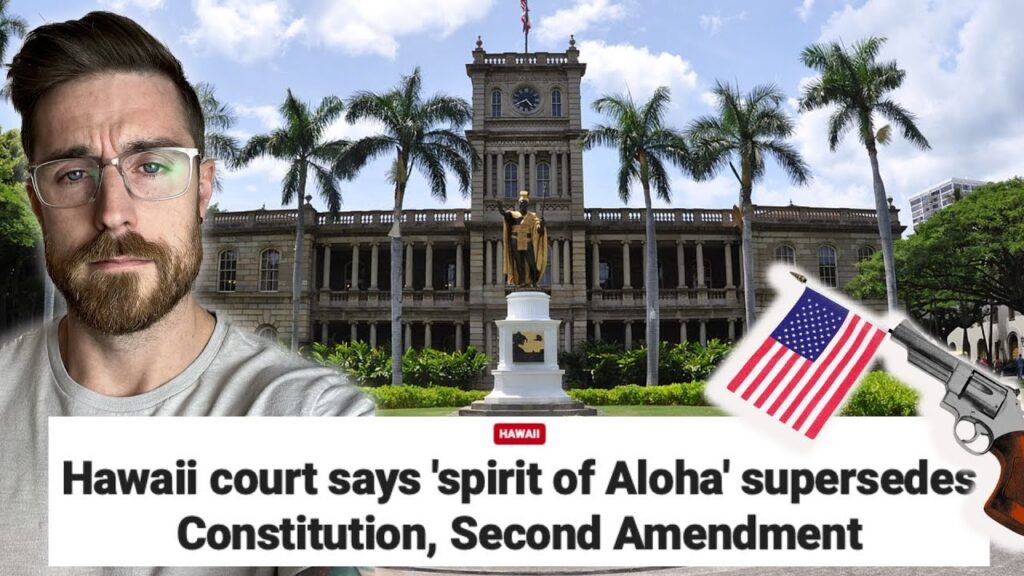
The legal battle over the Second Amendment has reached a strange and controversial frontier in the Pacific. In a recent legal debate, the Hawaii Supreme Court has questioned whether the state’s unique cultural history can supersede fundamental rights guaranteed by the Constitution. At the heart of the issue is the ‘Aloha Spirit,’ a concept that some justices believe should influence how the federal Constitution is interpreted within Hawaii. For gun owners and defenders of the Second Amendment, this judicial shift raises a critical question: does the right to bear arms apply uniformly across all 50 states, or can local tradition be used to strip away constitutional protections?
The Conflict Between Local Tradition and Constitutional Rights
The argument for Hawaii’s restrictive laws rests on the state’s pre-state history. Unlike the mainland states, which were established following a rejection of monarchical rule, Hawaii remained under a sovereign kingdom until 1893. In a dissent noted by critics, Justice Jackson pointed out that King Kamehameha III prohibited ‘dangerous weapons’ as early as 1833. Proponents of this view argue that because Hawaii never had a tradition of widespread firearm carrying, the Second Amendment should not apply in the same way there. However, this logic ignores the fundamental principle that the Bill of Rights was designed to prevent the government from infringing upon individual liberties, regardless of a state’s prior status.
Justice Eddins, writing in State v. Wilson, suggested that the ‘Aloha Spirit’ should inspire the court’s reading of the federal Constitution. This spirit is described as a ‘life force’ that encourages people to emote good feelings. While culturally significant, from the perspective of a firearms dealer or a constitutionalist, a ‘spirit’ is not a legal standard for fundamental rights. If a state can opt out of the Second Amendment based on local atmosphere, the concept of a uniform Bill of Rights begins to vanish.
The Precedent of Uniformity Across America
The U.S. Supreme Court has already addressed the idea of regionalized constitutional rights. In the landmark case McDonald v. Chicago, the Court explicitly ruled that the Second Amendment has the same meaning in all parts of the United States. This was further reinforced in New York State v. Bruen, where the Court clarified that local attitudes cannot shrink or inflate the meaning of fundamental Bill of Rights guarantees. Whether you are in the ‘Big Apple,’ the ‘Windy City,’ or the islands, the right to self-defense remains a core American protection.
Currently, statistics show a stark disparity: only about 8% of adults in Hawaii possess guns, compared to roughly 59% in mainland states. To justify this massive gap through the ‘spirit of Aloha’ suggests that the Fourteenth Amendment does not fully bind the states to the same constitutional protections for everyone. For those tracking the latest legal shifts, keeping an eye on the BT Gun Company is a licensed FFL dealer in Rubicon, Wisconsin. See FFL transfer pricing, learn how buying a gun online works, or shop firearms, ammo and gear.Buying or transferring a firearm?