
9mm vs. .45 ACP: Which is Better for Self-Defense?
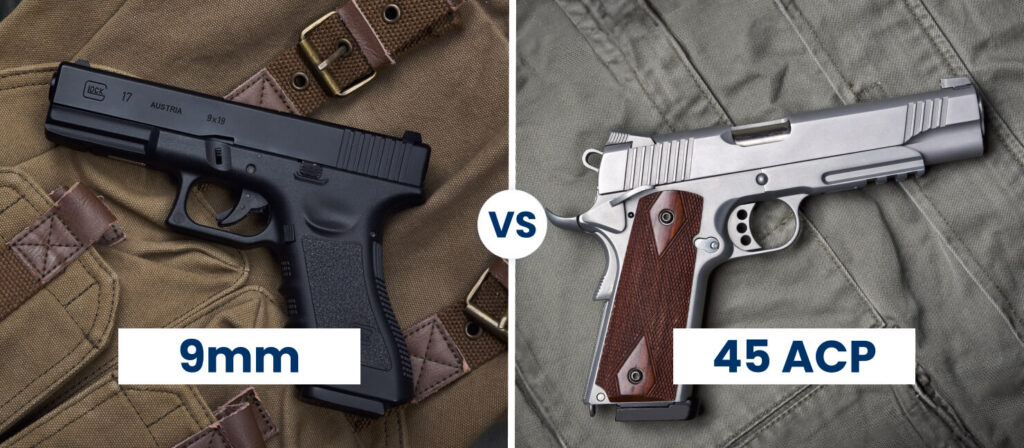
Quick Answer
For many shoppers comparing 9mm and .45 ACP for self-defense, 9mm offers a practical balance of magazine capacity, manageable recoil, handgun size and ammunition cost. In otherwise comparable pistol designs, the smaller 9mm cartridge generally permits greater capacity. Many shooters also find 9mm easier to manage, although felt recoil depends on the firearm, ammunition and individual shooter.
.45 ACP remains a reasonable choice for someone who prefers its larger-diameter projectile, already trains with the caliber or finds a particular .45-caliber pistol especially comfortable. Its tradeoffs can include lower capacity, a wider grip and greater ammunition expense, depending on the handgun and load.
Neither caliber provides a guaranteed outcome. Bullet construction, reliable firearm function, accurate placement and the shooter’s ability to operate the handgun consistently matter more than caliber reputation alone. Instead of choosing solely by the cartridge name, compare complete firearm-and-ammunition combinations. Consider grip fit, controls, capacity, recoil, maintenance needs, compatible magazines and the cost of regular practice. For most new buyers, 9mm is the more broadly practical starting point, while .45 ACP remains suitable for buyers who understand and accept its tradeoffs.
Capacity, Recoil and Firearm Size
Capacity is one of the clearest differences between these calibers. Because 9mm cartridges are narrower, a 9mm version of a similarly sized handgun will often hold more ammunition than its .45 ACP counterpart. Actual capacity depends on the pistol and magazine design, so compare manufacturer specifications rather than relying on general examples. Current federal, state and local law may also affect which magazines may be purchased or used.
Felt recoil is equally important, but caliber is not the only factor. Firearm weight, grip shape, action type and ammunition load all influence how a pistol feels. Many shooters perceive less recoil with 9mm than with .45 ACP in comparable handguns. A heavier pistol may feel softer than a lighter model chambered for the same cartridge.
Do not assume that every 9mm pistol will be slimmer or more comfortable. Some double-stack grips are relatively broad, while certain .45 ACP designs may fit a particular hand well. Compare individual handguns, not just caliber labels.
Projectile Performance Without the “Stopping Power” Hype
.45 ACP uses a larger nominal bullet diameter than 9mm, which is the source of its long-standing “bigger is better” reputation. However, caliber alone does not determine defensive ammunition performance. Projectile construction, velocity from the specific barrel, impact conditions and reliable feeding all matter. No defensive load can guarantee expansion or an immediate stop.
Modern projectile designs are offered in both calibers, and improvements in bullet construction have made 9mm a common defensive choice. That does not mean every 9mm load equals every .45 ACP load, nor does it make .45 ACP obsolete. It means shoppers should avoid choosing from reputation alone and review credible manufacturer information for the exact load under consideration.
When comparing ammunition, confirm the correct cartridge designation and review the firearm manufacturer’s guidance. Cost also matters because ammunition expense can influence how often an owner practices. Compare current options for both calibers rather than assuming that one load or cartridge will always cost less.
Evaluate the Complete Handgun System
A caliber decision should follow—not replace—the evaluation of the handgun itself. Grip dimensions, trigger reach, control placement, sights, overall size and weight can affect whether a pistol is comfortable and practical for its intended role. A well-fitting .45 ACP may be a better personal choice than a poorly fitting 9mm, and the reverse can be equally true.
Also consider the support equipment required for the exact model. Confirm that suitable magazines are made for the correct firearm and configuration. If the handgun will be paired with a holster, check compatibility with the precise model, optic and mounted accessories. When comparing holsters, focus on fit, material, retention features and comfort. Follow the firearm and holster manufacturers’ instructions and obtain qualified instruction.
For a home-defense handgun, overall size and weight may be less restrictive than they are for a firearm intended for regular carry. Even so, storage arrangements, household access considerations and maintenance requirements belong in the decision.
A Practical 9mm vs. .45 ACP Buying Checklist
- Choose 9mm when: Greater capacity in a comparable design, generally milder felt recoil or a potentially smaller grip is a priority.
- Choose .45 ACP when: You prefer its larger-diameter projectile, operate a particular .45-caliber pistol comfortably and accept the capacity and size tradeoffs.
- Compare exact models: Review dimensions, unloaded weight, capacity, controls and manufacturer specifications.
- Plan for ownership costs: Include ammunition, magazines, a compatible holster if needed, secure storage and cleaning and maintenance supplies.
- Confirm compatibility: Use only the ammunition, magazines and accessories specified for the firearm.
- Check the law: Review current federal, state and local requirements before purchasing, possessing, transporting or carrying any firearm or ammunition.
BT Gun Company is a licensed FFL dealer in Rubicon, Wisconsin and ships firearm orders to your local FFL. Review how buying a gun online works before placing an order.
Basic Safety Reminders
Treat every firearm as if it is loaded.
Keep the muzzle pointed in a safe direction.
Keep your finger off the trigger and outside the trigger guard until your sights are on the target and you have decided to shoot.
Be sure of your target and what is beyond it.
Before cleaning or inspecting a firearm, unload it, remove the magazine, lock the action open, and visually and physically check that the chamber is empty.

About the Author: Jeff Brown
Jeff Brown is CEO of Fuzzy Holdings LLC and owner of BT Gun Company, a Class 7 FFL dealer since 2023. An NRA-certified Range Safety Officer who has been shooting since 1983, he teaches hunter safety at his local gun club, hunts spring and fall turkey, and has a soft spot for revolvers.