Is the NFA Going Away? What Gun Owners Need to Know in 2026
Estimated reading time: 8 min
Summarize with AI
Share
Quick Answer
No, the National Firearms Act is not going away as of October 17, 2026. Federal legislation enacted in 2025 reduced the federal making and transfer tax to $0 for suppressors, short-barreled rifles, short-barreled shotguns, and weapons classified as “any other weapon,” effective January 1, 2026. However, those firearms remain regulated under the NFA.
For these items, gun owners generally must still:
- Submit the appropriate ATF Form 1 or Form 4.
- Provide fingerprints, identifying information, and a photograph when required.
- Complete the federal background-check and approval process.
- Wait for ATF approval before making or taking possession of the NFA firearm.
- Comply with state and local restrictions, which federal approval does not override.
The tax also did not disappear for every NFA category. Machine guns and destructive devices generally remain subject to the $200 federal making or transfer tax. Civilian acquisition of machine guns is additionally restricted by the Firearm Owners’ Protection Act of 1986, which generally bars possession of machine guns not lawfully possessed before May 19, 1986, except by qualified government entities and properly licensed industry participants.
The 2026 tax change is still a major victory for gun owners. Before it took effect, the standard federal tax was $200 for making an NFA firearm and usually $200 for transferring one, while an “any other weapon” transfer carried a $5 tax. Eliminating those taxes from commonly owned suppressors, SBRs, SBSs, and AOWs removes a substantial financial burden. It does not, by itself, repeal registration or turn those items into ordinary non-NFA firearms.
Lawsuits may challenge continued registration after the tax was reduced to zero, and Congress could repeal or substantially rewrite the NFA. Until Congress acts or a controlling court issues an effective ruling, owners should follow the current process described by the Bureau of Alcohol, Tobacco, Firearms and Explosives. Do not build an unapproved SBR or take home a suppressor merely because its federal tax is now $0.
What Actually Changed for NFA Firearms in 2026?
Public Law 119-21, enacted in 2025, amended the federal tax rates applied to several categories of NFA firearms. Beginning January 1, 2026, the federal making and transfer tax became $0 for suppressors, short-barreled rifles, short-barreled shotguns, and AOWs. The enacted text is available through Congress.gov.
The practical savings depend on the item. A buyer transferring a suppressor, SBR, or SBS previously paid a $200 tax in addition to the firearm’s purchase price and any dealer charges. An individual making an eligible NFA firearm on an approved Form 1 also ordinarily paid $200. Transfers of firearms classified as AOWs previously carried a $5 tax, although making an AOW generally carried the $200 making tax. Those federal taxes are now $0 for the covered categories.
This change is sometimes described online as removing suppressors or short-barreled firearms from the NFA. That description is inaccurate. Congress changed the tax rate without deleting the relevant items from the statute’s definition of “firearm.” The application, registration, background-check, and approval framework therefore remains in operation.
Machine guns and destructive devices were excluded from the zero-tax treatment and generally remain subject to the $200 tax. The NFA definition of a destructive device can include certain explosive devices and large-bore weapons, subject to statutory exceptions. Owners should never assume that a large-caliber or unusual firearm is exempt without checking its classification.
What Does the NFA Still Require?
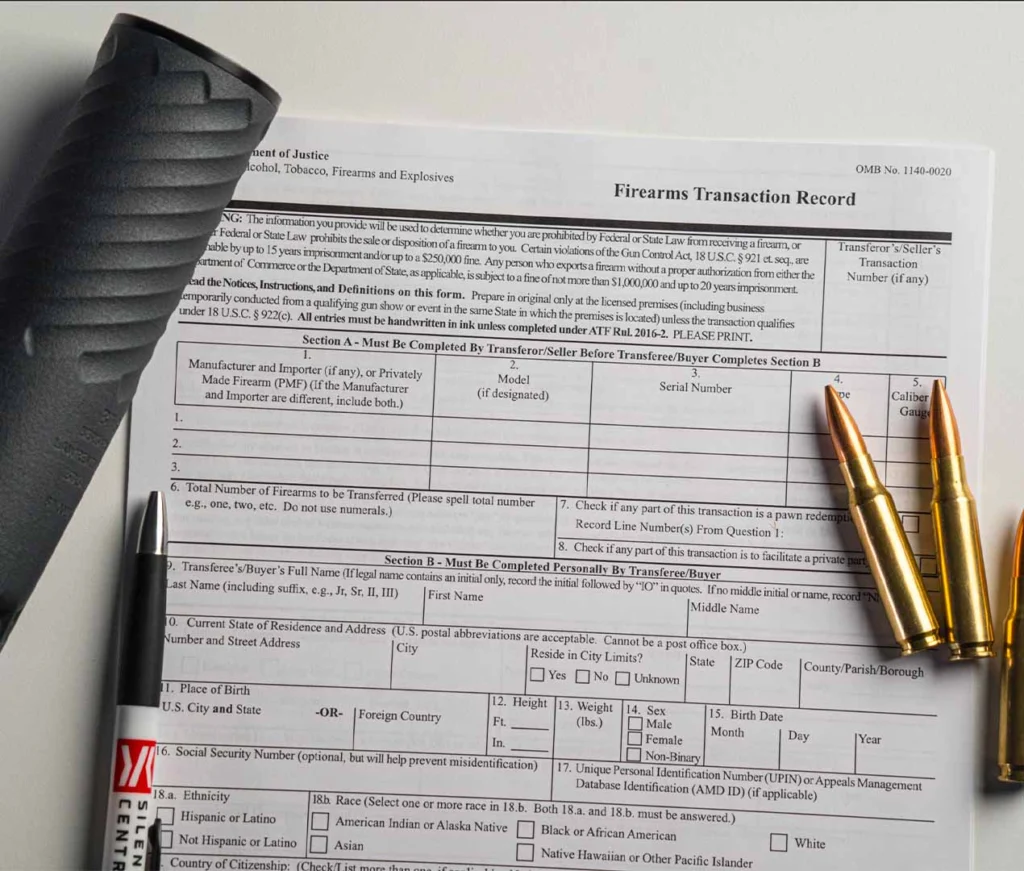
A $0 tax is not the same thing as no federal paperwork. A person purchasing an already manufactured suppressor, SBR, SBS, or AOW normally uses ATF Form 4 to request the transfer. A person who intends to make an NFA firearm, such as lawfully converting a rifle into an SBR, normally applies on ATF Form 1 before making it.
Individual applicants and responsible persons associated with trusts or legal entities may be required to submit fingerprints, photographs, identifying information, and responsible-person documentation. ATF then reviews the application and determines whether the transfer or making would violate federal, state, or local law.
Approval must come first. A buyer may pay for a suppressor and leave it with the transferring dealer, but the dealer generally cannot release it until the approved transfer is returned. Likewise, filing a Form 1 does not authorize someone to assemble the proposed NFA configuration while the application is pending.
Registration also remains important. The National Firearms Registration and Transfer Record documents registered NFA firearms and their lawful registrants. Owners should retain copies of approved forms and keep them accessible. A nonlicensee making an NFA firearm may also have federal marking obligations, including required maker identification. Review current ATF instructions before engraving or assembling anything.
These rules apply whether an owner purchases through BT Gun Company, another licensed dealer, or makes an eligible firearm after receiving Form 1 approval. The absence of a tax payment does not authorize an otherwise prohibited transfer or configuration.
How the National Firearms Act Works
Congress enacted the National Firearms Act in 1934. Rather than broadly prohibiting every covered firearm, the law created a federal taxation and registration system governing machine guns, short-barreled rifles, short-barreled shotguns, suppressors, destructive devices, and AOWs. Later federal laws amended that framework, including the Gun Control Act of 1968 and the Firearm Owners’ Protection Act of 1986.
An SBR generally includes a rifle with a barrel under 16 inches or an overall length under 26 inches, subject to the complete statutory definition and ATF measurement rules. An SBS generally includes a shotgun with a barrel under 18 inches or an overall length under 26 inches. Suppressors are separately defined under federal law and can be regulated even when they are not attached to a firearm.
AOW is a technical category rather than a catch-all label for every unconventional gun. It can encompass certain concealable weapons capable of discharging a shot through the energy of an explosive, including some smoothbore pistols and disguised firearms. Classification depends on the weapon’s design and configuration, so owners should not rely on photographs, product nicknames, or social-media opinions.
The NFA also intersects with the Gun Control Act. A dealer transferring an NFA firearm must hold the appropriate federal firearms license and special occupational tax status. The transferee must be legally eligible to possess firearms, and the firearm must be legal in the recipient’s jurisdiction. For current regulatory developments affecting owners and dealers, follow the latest firearms news.
What the Change Means in Practice for Gun Owners
The most immediate benefit is lower acquisition cost. A customer purchasing a suppressor no longer adds a $200 federal transfer tax for that covered item. Someone receiving approval to make an SBR no longer owes the former $200 federal making tax. The firearm, suppressor, dealer service, trust preparation, engraving, shipping, or local fees may still cost money; only the specified federal NFA tax changed.
State law remains a separate issue. Some states prohibit or restrict suppressors, SBRs, SBSs, machine guns, or other NFA firearms. A federal approval does not create a right to possess an item prohibited by state law. Rules may also change when an owner moves or travels across state lines.
Federal prior approval on ATF Form 5320.20 is generally required before a nonlicensee transports an SBR, SBS, machine gun, or destructive device interstate. Suppressors and AOWs generally are not subject to that particular federal prior-approval requirement, but every destination and transit state must still allow possession. Owners should verify current law before traveling.
The change may also increase demand for suppressors and short-barreled firearms. Buyers should choose products based on intended use, host compatibility, caliber rating, mounting system, and manufacturer instructions rather than assuming every suppressor works safely on every firearm. When you are ready to browse firearms, work with an experienced FFL and confirm all legal requirements before ordering.
Could Congress or the Courts Eliminate the NFA?
Congress can repeal the NFA, remove particular items from its coverage, or replace registration with a different regulatory approach. Pro-Second Amendment organizations have long argued that suppressors and short-barreled firearms should be treated like ordinary firearms rather than subjected to a special federal registry. The 2026 tax reduction represents meaningful relief, but it is not full deregulation.
Litigation presents another possible route. Because the Supreme Court historically discussed the NFA as an exercise of Congress’s taxing authority, reducing a tax to zero has prompted arguments that continued registration and approval requirements lack their former tax-related foundation. Other constitutional arguments may rely on the Second Amendment and the historical-tradition test applied in modern firearms cases.
Those arguments do not automatically suspend the statute. A lawsuit being filed, a trial court issuing a decision, or an advocacy group announcing a challenge does not necessarily create nationwide relief. Court orders can be stayed, limited to particular plaintiffs, or reversed on appeal. Owners should look for the exact text, effective date, jurisdiction, and scope of any ruling.
Unless a valid statute or controlling court order says otherwise, ATF will continue administering the NFA. Responsible gun owners can support reform while avoiding preventable felony exposure. Consult a qualified firearms attorney for advice about a disputed classification, an unregistered item, estate transfer, trust, or state-specific restriction.
Common NFA Mistakes and Frequently Asked Questions
Can I take a suppressor home immediately because the tax is $0?
No. The covered federal transfer tax is $0, but the suppressor remains an NFA firearm. The transferring dealer generally must retain it until ATF approves the transfer and all other release requirements are satisfied.
Can I assemble an SBR while my Form 1 is pending?
No. Submission is not approval. Do not make the regulated configuration until ATF has approved the application. Be mindful of the parts and configurations in your possession, especially when a short barrel could be installed on a rifle receiver.
Did machine guns become tax-free?
No. Machine guns and destructive devices generally remain subject to the $200 NFA tax. Machine guns are also governed by the 1986 federal restriction, which generally prevents ordinary civilians from acquiring machine guns that were not lawfully possessed before May 19, 1986.
Does an approved federal form override a state ban?
No. ATF approval does not override state or local law. An item must be lawful where it will be possessed, and interstate transportation may trigger additional federal and state requirements.
Should I cancel an application because people say the NFA was repealed?
No. Verify information through ATF, enacted legislation, controlling court orders, and competent legal counsel. Viral posts often confuse a zero-dollar tax with repeal of the underlying registration system.
The bottom line is straightforward: the NFA remains in force, although the elimination of federal taxes on commonly owned suppressors, SBRs, SBSs, and AOWs is an important win for American gun owners. For dependable service, firearm availability, and updates that affect lawful ownership, visit BT Gun Company.

About the Author: Jeff Brown
Jeff Brown is CEO of Fuzzy Holdings LLC and owner of BT Gun Company, a Class 7 FFL dealer since 2023. An NRA-certified Range Safety Officer who has been shooting since 1983, he teaches hunter safety at his local gun club, hunts spring and fall turkey, and has a soft spot for revolvers.