
What Is a CCW Permit? Concealed Carry Laws Explained
Quick Answer
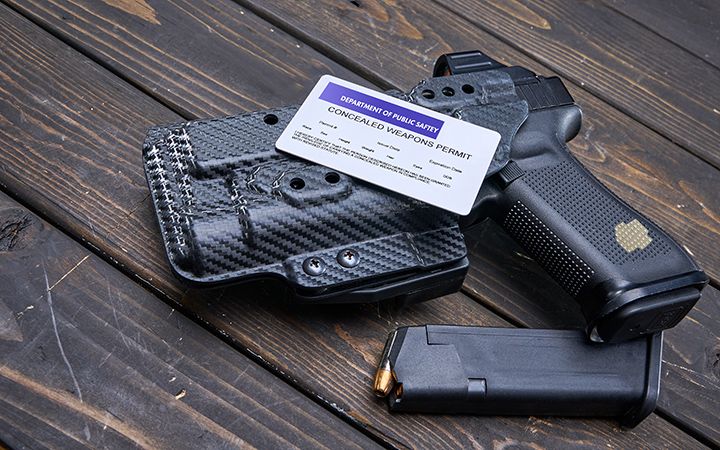
A CCW permit is a state or local license that authorizes an eligible person to carry a concealed firearm or other covered weapon in the issuing jurisdiction. CCW commonly means carrying a concealed weapon or concealed carry weapon. Depending on the state, the credential may instead be called a concealed handgun license, concealed pistol license, license to carry, or concealed weapon or firearm license.
There is no general federal CCW permit for civilians. Each state establishes its own eligibility rules, application process, fees, training requirements, restricted locations, and reciprocity policies. In some states, qualified adults may carry without a permit, but an optional permit can remain valuable for interstate reciprocity and other state-specific benefits.
- What it usually covers: Carrying a loaded handgun hidden from ordinary observation, subject to state and local law. A license with the word weapon may cover more than handguns, but its scope depends on the issuing law.
- Typical requirements: Applicants may need to meet minimum-age and residency rules, submit fingerprints and photographs, pass a background check, pay a fee, and complete classroom or live-fire training.
- What it does not do: A CCW permit does not override federal firearm prohibitions, authorize carry everywhere, or automatically become valid in every other state. It also does not replace any separately required permit to purchase or acquire a firearm.
- Where restrictions may apply: Schools, courthouses, government buildings, secure airport areas, polling places, establishments serving alcohol, posted private property, and other sensitive locations may be restricted. The exact list varies significantly by jurisdiction.
- Reciprocity: Another state may recognize your permit, recognize only resident permits, impose different age limits, or decline recognition entirely. When traveling, you must follow the law of the state you are physically in.
A permit is only one part of lawful concealed carry. Gun owners should understand safe handling, proper holster use, prohibited locations, vehicle rules, use-of-force law, renewal deadlines, and any duty to inform law enforcement. Review official state guidance before carrying or crossing state lines. BT Gun Company also provides firearm resources for responsible, informed gun ownership.
What CCW Means in Different States
CCW is a convenient national shorthand, but permit names and legal scope are not uniform. Florida issues a Concealed Weapon or Firearm License, while Texas calls its credential a License to Carry a Handgun. Pennsylvania uses License to Carry Firearms, and other jurisdictions use terms such as concealed handgun permit or concealed pistol license.
The title matters less than the governing statute. Some licenses address concealed handgun carry only, while others may include additional weapons. A permit that authorizes concealed carry may not authorize open carry, and open carry rules can differ by location, age, firearm type, and manner of carry. Texas, for example, uses its handgun license within a legal framework that addresses both open and concealed handgun carry. Applicants can review the Texas Department of Public Safety handgun licensing information for official details.
A CCW permit generally is not tied to a particular caliber, so common defensive chamberings such as 9mm or .380 ACP may be carried if the firearm and method of carry are otherwise lawful. However, some jurisdictions place specific firearms or qualification information on a license. Never assume one state’s rules apply in another.
How Do You Get a Concealed Carry Permit?
The application normally goes through a state police agency, public-safety department, county sheriff, court, or another designated licensing authority. Resident and nonresident applications may follow different procedures. Common steps include completing an application, proving identity and residency, submitting fingerprints, consenting to a criminal-history check, paying required fees, and completing mandated training.
Training standards vary widely. A jurisdiction may require legal instruction, safe storage education, a written test, range qualification, or no training at all. Processing time, permit duration, renewal rules, and address-change requirements also depend on local law. A criminal conviction is not the only possible disqualifier; federal prohibited-person rules and state-specific restrictions can involve domestic-violence orders, certain mental-health adjudications, unlawful drug use, immigration status, or age.
Approval of a permit does not necessarily authorize firearm ownership or acquisition if another law prohibits it. Applicants must answer every question truthfully and should use the issuing agency’s current forms rather than relying on an old checklist. Florida applicants, for example, can find current instructions through the state’s official concealed weapon license portal.
Permitless Carry and Interstate Reciprocity
Permitless carry, sometimes called constitutional carry, generally means an eligible person may carry under specified circumstances without first obtaining a state carry license. It does not mean unrestricted carry. Minimum ages, prohibited-person laws, sensitive-place restrictions, vehicle rules, and limits affecting nonresidents can still apply.
Many gun owners maintain an optional permit because recognition agreements may allow licensed carry in additional states. Reciprocity is not a national guarantee. Recognition can change, and the destination state’s rules control how, where, and by whom a handgun may be carried. A state may recognize your home-state resident permit but reject a nonresident permit issued by the same authority.
Federal law adds another important distinction. The federal Gun-Free School Zones Act contains a licensing exception with specific conditions tied to a license issued by the state in which the school zone is located. Ordinary interstate reciprocity should not be assumed to satisfy that federal exception. Federal safe-passage protections for transporting unloaded, inaccessible firearms also are not a substitute for a CCW permit or permission to carry a loaded handgun.
Before traveling, verify each state’s law through the relevant attorney general, state police, or licensing agency. Secondary summaries can become outdated quickly. Readers can also follow latest firearms news for developments affecting lawful gun owners.
Responsibilities That Come With Concealed Carry
A CCW permit confirms licensing status; it does not establish judgment, skill, or immunity from criminal and civil consequences. Responsible carriers should use a purpose-built holster that covers the trigger guard, securely retains the handgun, and remains stable during normal movement. The firearm should be handled only when necessary and carried in accordance with its manufacturer’s instructions.
Know whether your state requires immediate disclosure to law enforcement, disclosure only when asked, or no affirmative notification. During an encounter, keep your hands visible, avoid sudden movement toward the firearm, and follow lawful instructions. Also learn how posted signs, private-property requests, alcohol-related locations, public demonstrations, and emergency declarations affect carry.
Regular practice should include safe gun handling, accurate shooting, malfunction clearance, decision-making, and lawful de-escalation. A compact 9mm or .380 ACP may be easier to conceal, but the best defensive firearm is one the owner can operate safely, shoot competently, and carry in a secure holster. Gun owners ready to shop firearms or research suitable defensive equipment should evaluate reliability, fit, capacity, recoil, and safe storage rather than choosing on size alone.
For dependable firearm options, responsible ownership resources, and knowledgeable service from a licensed FFL, visit BT Gun Company.

About the Author: Jeff Brown
Jeff Brown is CEO of Fuzzy Holdings LLC and owner of BT Gun Company, a Class 7 FFL dealer since 2023. An NRA-certified Range Safety Officer who has been shooting since 1983, he teaches hunter safety at his local gun club, hunts spring and fall turkey, and has a soft spot for revolvers.